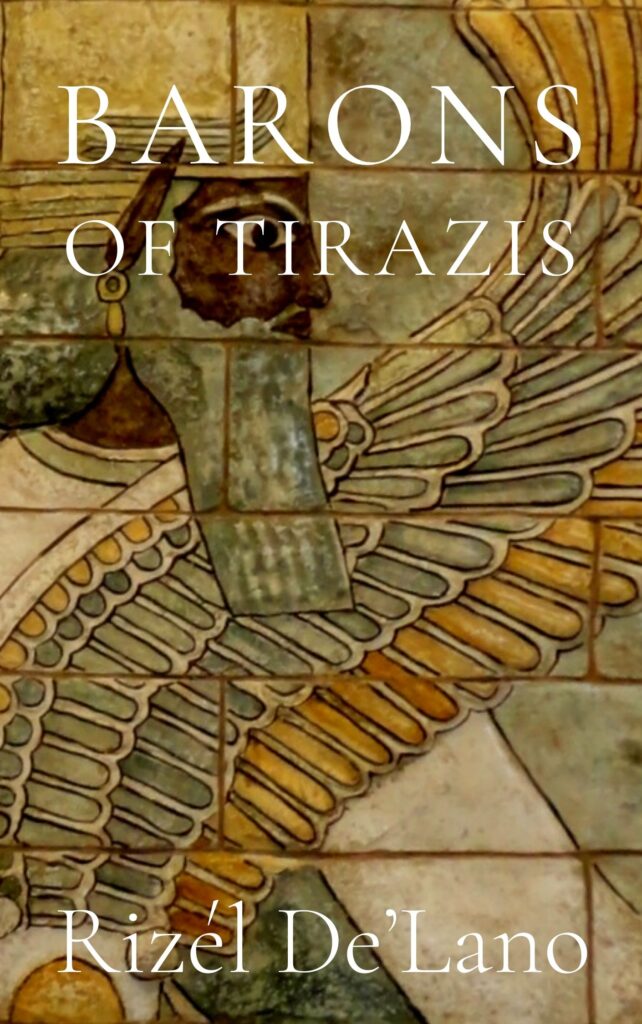
BARONS OF TIRAZIS
It is the year 2 BC, Phraates IV was King of Kings of the Parthian Empire from 37 to 2 BC. He was the son and successor of Orodes II (r. 57–37 BC), and was given the throne after the death of his brother Pacorus I. Phraates IV soon murdered all his brothers, and also his father. And now, he has been murdered by his concubine wife Musa, who will rule Persia with her son.
While the Romans and Persian kings fought among themselves for power, the Barons took charge of wealth, many of them with no imperial lineage but autokrators, those who ruled by themselves, for themselves, with no desire to be king, only to amass wealth and prestige.
This unofficial rule of the nation by an elite is inevitable seen as an “iron law” as part of the “tactical and technical necessities” of the empire.
Darian was elected, not by desire or choice, nor by lineage, pen or paper, but by the forces of his accumulated wealth and business acumen, as one of the most influential and respected Baron elites of that time.
Which made him a very dangerous man. Especially because he did not consider himself as part of the elites, but as an independent, the one who could not be persuaded by politics.
And yet, he found himself in the middle of it, expected to lead the Seven Houses to overthrow Musa and put on the throne the rightful king.
Extract from chapter one:
Darian promoted saffron cultivation among impoverished farmers of the northern regions in the empire as an ideal augmentation to his lucrative opium production that favoured the same soil as his Shiraz vineyards, the sunny and semi-arid climate most ideal for growth.
‘Excuse me Sire, I have a message from the House of Suren.’
Baber, one of Darian’s azadans, a man of a slightly lower nobility class and part of his household, interrupted his thoughts when barging through the door. He never entered quietly, it was not part of his manner.
‘It came this afternoon through the Chapar Khaneh.’
Chapar Khaneh was the first courier service system used since the Achaemenid Empire, created by Cyrus the Great and later developed further by Darius the Great as a method of communication throughout the Persian territories. The system consisted of a series of stations along a 2,500 mi highway throughout the empire, where the Chapars would deliver post from one part of the kingdom to another on horseback.
Damian gave Barber a fond smile. The meaning of Baber’s name translated as courageous lion. Instantly fierce and unforgettable, a man with strength, bravery and a whole lot of attitude that always made an impression.
Darian took the document from his extended hand and considered the seal. It was from Gondophares. Although Old Persian was the Persians’ native tongue, Aramaic was the administrative language of the empire and thus used in composing messages throughout it.
Baber waited for Darian to investigate the contents of the envelope, eyeing the goblet with wine and the food tray placed next to it.
Damian saw his gaze, smiled and offered. ‘Wine?’
‘No thanks my lord.’
‘Some bread and bacon?
‘No thank you my lord.’
‘Come on, sit, I insist.’
Barber grinned.
‘Sit with me afterwards for a game of shatranj, we have some matters that need attention,’ said Darian.
While Baber feasted on the food and drink, Darian frowned. The message signified a new beginning of concern for the Barons.
Baber readied the chess table and shifted a cushion closer, waiting for Darian to leave his thoughts and join.
While shatranj originated in the Indian game chaturanga, it was the Persian version that spread to other parts of the world and gave rise to all the current-day variants such as Chinese Xiangqi, and the Japanese Shogi.
Some terms were from Persian origin, such as checkmate, coming from shah mat or the King is dead.
‘King Frahāt is dead,’ said Darian as he moved his queen on the board.
Barber looked up from the game but said nothing, waiting for Darian to continue.
Frahāt or also known as Phraates IV was King of Kings of the Parthian Empire for the past 37 years. He was the son and successor of Orodes II who reigned for 20 years before him, and was given the throne after the death of his brother Pacorus I.
Phraates IV murdered all his brothers, and also possibly his father. His actions alienated the Armenians and also some of his nobles, including the distinguished Monaeses, who fled to the Roman triumvir Mark Antony, but shortly returned and reconciled with Phraates IV.
Phraates IV was attacked 36 years ago by Mark Antony, who marched through Armenia into Media Atropatene, and was defeated and lost the greater part of his army. Antony, believing himself betrayed by Artavasdes II, king of Armenia, invaded his kingdom, took him prisoner, and concluded a treaty with Artavasdes I, king of Media Atropatene.
But when the war with Octavian broke out, Antony could not maintain his conquests; Phraates IV recovered Media Atropatene and made Artaxias, the son of Artavasdes II, king of Armenia.
Around the same time, Phraates IV’s throne was usurped by Tiridates II, but he quickly managed to reestablish his rule with the aid of Scythian nomads. Tiridates fled to the Romans, taking one of Phraates IV’s sons with him.
In negotiations conducted 20 years ago, Phraates IV arranged for the release of his kidnapped son. In return, the Romans received the lost legionary standards taken at Carrhae before, and any surviving prisoners of war. The Parthians viewed this exchange as a small price to pay to regain the prince.
Along with the prince, Octavian gave Phraates IV an Italian slave-girl named Musa, who quickly became queen and a favourite of Phraates IV, giving birth to Phraataces (Phraates V).
Seeking to secure the throne for her son, Musa convinced Phraates IV to send his four first-born sons (Vonones, Phraates, Seraspandes and Rhodaspes) to Rome in order to prevent conflict over his succession.
From the context in the confidential letter Darian just received, Musa, also known as Thea Musa, had Phraates IV poisoned and by force made herself Queen along with her own son Phraates V, and become the co-rulers of the empire. Musa was the first woman to rule Persia.
‘Persia now has a basilissa, a queen,’ said Darian. ‘Along with her son Phraates V.’
Baber said nothing.
Darian continued. ‘Are our businesses in any immediate danger?’
‘No Sire.’
‘All of them?’
‘Yes Sire.’
Each time a new king was announced uncertainty grew about the manner the reign would transpire. Most kings were more concerned about their own advancement and importance, enjoying the luxuries and organisations of the previous king.
‘I don’t think there would be much change by the queen or her son,’ said Baber, but did not elaborate on the reasons for it.
But Darian knew from history there were always some who wanted to make their mark in some other ways and changed the order of things.
And the order of things must be protected.
BOOK LAUNCH DATE: June 2027
Barons Of Tirazis is the first of a trilogy to be published in 2028 and 2029.